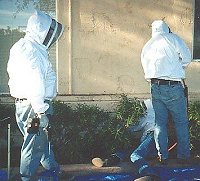
 Identify the location and approximate size of
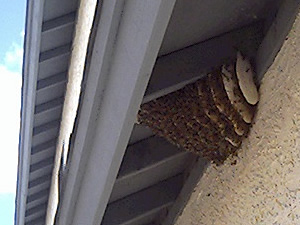
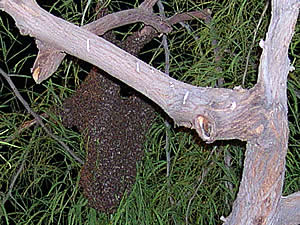
the bee swarm or hive FROM A SAFE DISTANCE - USE CAUTION. Identify the location and approximate size of
the bee swarm or hive FROM A SAFE DISTANCE - USE CAUTION.- Remember: Keep children and pets away from the swarm or
hive.
- Notify us of the problem immediately.
- Identify for us any possible emergency information such as
aggressive behavior, attacks on people or pets, allergies to
bee stings, etc.
- Do not spray the swarm or hive with water or any other
substance to move the bees - this will only aggravate them.
- Always be alert. Bees will normally attack only when their
nesting area is disturbed. Approach potential bee
nesting locations (such as mailboxes, meter boxes, thick
bushes and debris piles with CAUTION. Watch for winged
insects flying in and out of openings and listen for the
"buzz" or "hum" sound of a nearby bee nest.
- Never tie or pen pets and animals near a bee nest or swarm,
regardless of how docile they may seem.
- The vibration from machinery may agitate nesting
bees. Use extra caution when using lawn mowers, weed
eaters and powered equipment. This vibration is
offensive to the bees and may provoke an attack.
- Prevent bees from nesting in or around your home by sealing
cracks and holes in structures under the eves and by filling
all void spaces. Remove debris (such as wood piles, old cars
and trash) to reduce nesting locations. If ventilation
must be maintained through a hole, cover it with a fine screen
(available at any hardware or home center store).
- When working in your yard or participating in outdoor
recreation activities, avoid wearing dark clothing, as that is
more threatening to bees. Certain perfumes,
after-shaves, hair sprays, sunscreens, and the smell of
freshly mowed grass have also been known to provoke bees.
- If you see a nest or swarm of bees, assume they are
Africanized Honeybees and LEAVE THEM ALONE! It is
impossible to distinguish Africanized bees from common
honeybees from a distance.
- IF YOU ACCIDENTALLY DISTURB A COLONY OF BEES, YOU SHOULD:
- GET AWAY from them as QUICKLY AS POSSIBLE! If you
are being stung, RUN to a SHELTER if possible. If your
vehicle is close, get back in your vehicle and roll up the
windows. Once inside your vehicle, DRIVE a short
distance, then STOP and CLEAR any stray bees from the
interior. If you are not near a vehicle or shelter,
RUN as far and as fast as possible. While running,
pulling your shirt up over your head may help, since bees
tend to target the head and eyes.
- DO NOT try to SWAT at the bees. Movement of this
type will only attract more bees.
- DO NOT JUMP into a POOL. It is common for the bees
to attack again when you surface for air. If you
become incapacitated from a bee sting reaction, you might
drown.
- If you have been stung, DIAL 9-1-1 once you are safely
away from the bees. Bee stingers may continue to
inject venom for several minutes once they are imbedded in
your skin. While a few stings may not be harmful to
most people, multiple stings can cause a serious health
problem. A SINGLE STING CAN BE FATAL TO SOMEONE WHO IS
ALLERGIC TO IT! Watch for these signs of an allergic
reaction: local pain, swelling, hives and especially
difficulty breathing. If you experience any of these
symptoms, DIAL 9-1-1 IMMEDIATELY. An ALLERGIC REACTION
to bee stings can go from mild symptoms to DEATH in a very
short period of time.
|